OUR IMPACT
For over a decade, ELI has worked where environmental crime actually operates: at the point of convergence, where the trafficking of wildlife, timber, fish, and other natural resources meets money laundering, corruption, drug trafficking, and other serious transnational crime. Our model is built on professional intelligence, not awareness campaigns — we identify the high-level criminals, map their networks, understand their modus operandi, follow their money, and place that intelligence in the hands of the agencies that can act on it.
The results below reflect that approach. Because much of our fieldwork is covert — and many outcomes unfold inside investigations we cannot publicly claim — these figures are a floor, not a ceiling. But they show the scale, reach, and seriousness of what professional intelligence brings to the fight against Environmental Crime Convergence and the criminal exploitation of nature.
MORE THAN A DECADE OF PROFESSIONAL INTELLIGENCE
Reach & fieldwork: 10+ years of field work – 30+ countries – hundreds of field missions and undercover intelligence operations in all continents
Intelligence produced: Detailed intelligence on 2,000+ Persons of Interest, including some of the most important international traffickers in the world – 180+ transnational criminal networks mapped and investigated – dozens of trafficking routes identified – 300+ Confidential Reports delivered to government agencies and policy makers – financial intelligence on how criminal networks move and launder their profits – first-hand intelligence and evidence on the convergence of environmental/wildlife crime with other serious crimes
Action & impact: 30+ key international traffickers arrested – $15M+ in traffickers’ goods and assets seized in operations supported by our intelligence – dozens of official investigations triggered – Hundreds of international wildlife traffickers have had their U.S. visas revoked as a direct result of intelligence provided by ELI – millions reached through global media collaborations – ongoing work with top academic institutions on education and joint research projects
FROM THE FIELD TO ACTIONABLE INTELLIGENCE
ELI’s impact begins where the crimes happen. Since our first field operations in 2014, our investigators and undercover operators have carried out hundreds of investigative missions across more than 30 countries in Africa, Asia, Latin America, North America, and Europe — getting close to the people who run these networks and gathering intelligence no desk-based analysis can reach.
That fieldwork has identified over 1,100 Persons of Interest and mapped more than 150 transnational trafficking and criminal networks — not only the traffickers themselves, but the brokers, financiers, and corrupt officials who make their work possible. We trace how these networks are structured, how they operate, and how they move their money.
We then turn that raw intelligence into something authorities can act on. Our work has supported the arrest of more than 30 key individuals — including some of the most significant wildlife traffickers ever apprehended — and has fed investigations, prosecutions, and disruption efforts that continue out of public view.
But arrests are only the most visible measure of our work, and not the most important one. ELI’s model is built to deliver relevant, high-grade intelligence to the government agencies, law-enforcement bodies, financial institutions, and international organizations responsible for driving systemic change. A single Confidential Intelligence Brief, placed in the right hands, can do more lasting damage to a criminal network than a dozen isolated seizures. That is the impact we are built to create.
ENVIRONMENTAL CRIME CONVERGENCE: WHERE OUR INTELLIGENCE GOES FURTHER
What sets ELI apart from every other organization in this field is that we don’t stop at the crime against nature — we follow it to everything it’s connected to.
The networks that traffic wildlife, timber, and fish rarely deal in those alone. The same routes, the same brokers, and above all the same money-laundering systems move drugs, weapons, counterfeit goods, and people. Treating a single seizure as an isolated event misses the organization behind it; tracing the convergence — the money, the corruption, the parallel criminal enterprises — exposes the whole structure.
This is where ELI’s intelligence reaches beyond enforcement-by-seizure. Our investigators gather first-hand intelligence on how these networks operate as businesses: how they move and launder their profits — including through shadow banking and informal value-transfer systems such as Chinese “flying money” (feiqian) — who protects them, and how their environmental crimes connect to drug trafficking, corruption, and national-security concerns.
Several of our investigations and public reports have traced these connections in detail — mapping how the proceeds of environmental crime are laundered, how criminal networks overlap across different illicit markets, and how corruption enables them to operate. This is intelligence that conventional wildlife-crime reporting cannot provide, and it gives law enforcement and policymakers a picture of the criminal economy as a whole.
Because we map these connections, our intelligence lets authorities treat environmental crime as what it really is — serious, organized, transnational crime — and pursue the high-level actors who would otherwise remain invisible.
“Our partnership with ELI is invaluable. Their access to these particular criminal networks is simply something we can’t do.”
Chris Egner, Special Agent at U.S. Homeland Security Investigations (HSI)
THE CONFIDENTIAL INTELLIGENCE BRIEF: OUR CORE PRODUCT FOR GOVERNMENT AGENCIES
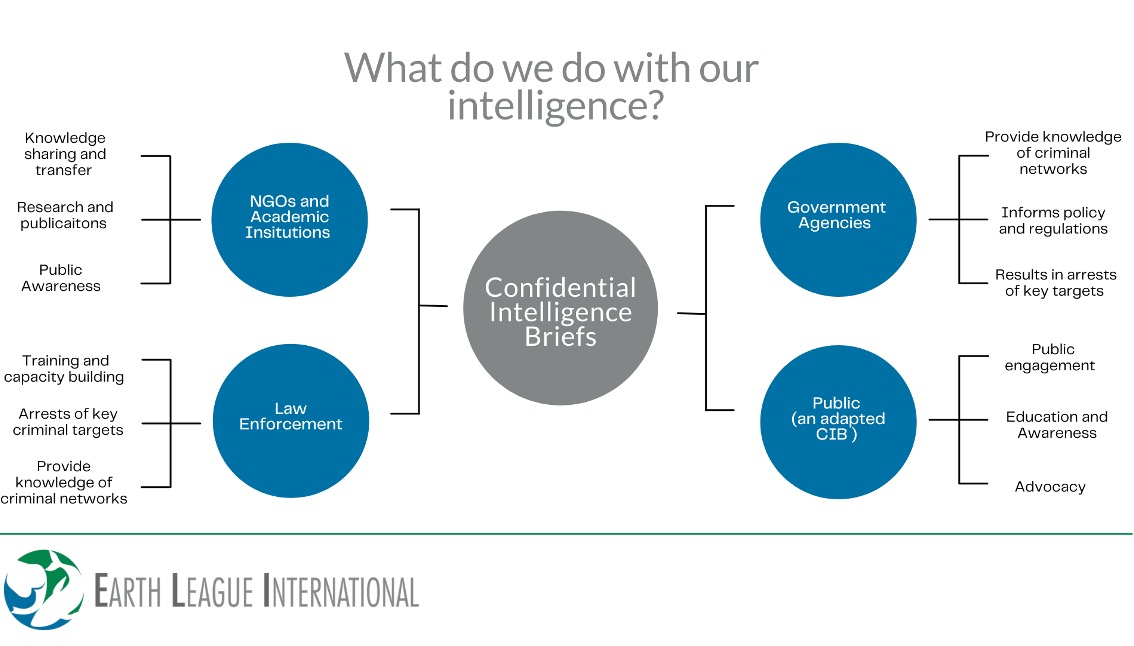
At the conclusion of an operation, ELI produces a Confidential Intelligence Brief (CIB) — the single most important output of our investigative and intelligence work, and the point where months or years of fieldwork become something authorities can act on.
A CIB is not a report in the conventional sense. It gives a law-enforcement or government agency the actionable picture of a criminal network — the key individuals, their methods, their connections, and their vulnerabilities — together with the evidence to support immediate action: arrests, prosecutions, seizures, or the disruption of an entire trafficking structure. It can also point authorities toward the gaps in policy and enforcement that let these networks operate in the first place.
Over more than a decade we have produced and shared CIBs with law-enforcement and government agencies in the United States, Mexico, Bolivia, Peru, Colombia, the Netherlands, Kenya, Tanzania, South Africa, Thailand, and other countries — as well as with international bodies including Interpol, CITES, and UNODC. Each one places reliable, first-hand intelligence directly in the hands of those with the authority to act on it.
WORKING WITH GOVERNMENTS AND PARTNERS
ELI’s intelligence is only as valuable as the action it enables — which is why our relationships with the agencies and organizations that can act on it are themselves a core part of our impact.
We work alongside governmental and non-governmental bodies around the world, supporting their intelligence, investigative, and law-enforcement operations by sharing usable, actionable intelligence with trusted partners. Through the steady exchange of our Confidential Intelligence Briefs, we have built close, working relationships with many of the key decision-makers in the global fight against environmental crime — relationships that extend our reach well beyond what any single NGO could achieve alone.
We also help build the capacity of others. ELI experts are regularly invited to brief and train partners — both at major international events and in closed-door meetings — convened by bodies including government agencies, the United Nations Office on Drugs and Crime (UNODC), Interpol, and CITES, sharing hard-won field and analytical experience with the people on the front lines.
Our partners among NGOs and academic institutions include IUCN Netherlands, IFAW, John Jay College of Criminal Justice, Florida International University and the International Coalition Against Illicit Economies (ICAIE). ELI is a member of IUCN and a founding member of the Nature Crime Alliance.
WILDLEAKS: A WORLD-FIRST FOR ENVIRONMENTAL CRIME
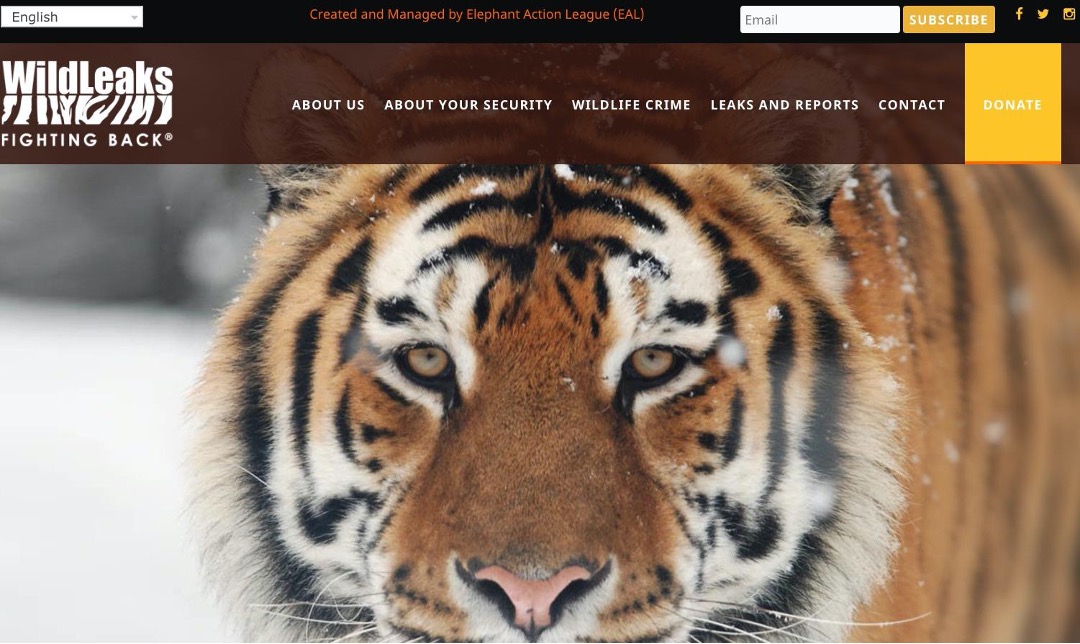
In 2014, ELI built and launched WildLeaks — the world’s first secure whistleblowing platform dedicated to environmental and wildlife crime. Created and overseen by our own technology experts and built on the Tor network, it allows anyone, anywhere, to share sensitive information about environmental crimes safely and anonymously.
WildLeaks exists because some of the most valuable intelligence comes from people on the inside — those who witness trafficking, corruption, or the destruction of nature and want to act, but cannot risk exposure. The platform gives them a protected channel to do so.
Since launch, WildLeaks has received more than 300 submissions from individuals in over 30 countries — from China and Thailand to Kenya, Russia, Mexico, and Brazil. The most credible of these have fed directly into our investigations and been shared with trusted law-enforcement agencies, NGOs, and media partners, turning a single act of conscience into real-world action against criminal networks.
In one recent case, tips submitted through WildLeaks launched a year-long ELI investigation into the conservation of Russia’s Amur tiger — surfacing allegations of manipulated population data, suppressed independent research, and links between tiger poaching and other organized criminal activity that official narratives had kept out of view.
PUBLIC AWARENESS AND ADVOCACY
Exposing criminal networks is one half of ELI’s mission; making the public understand the scale of the threat is the other. Environmental crime thrives on invisibility — and over the past decade we have partnered with leading figures in film, journalism, and publishing to bring it into view for millions of people worldwide.
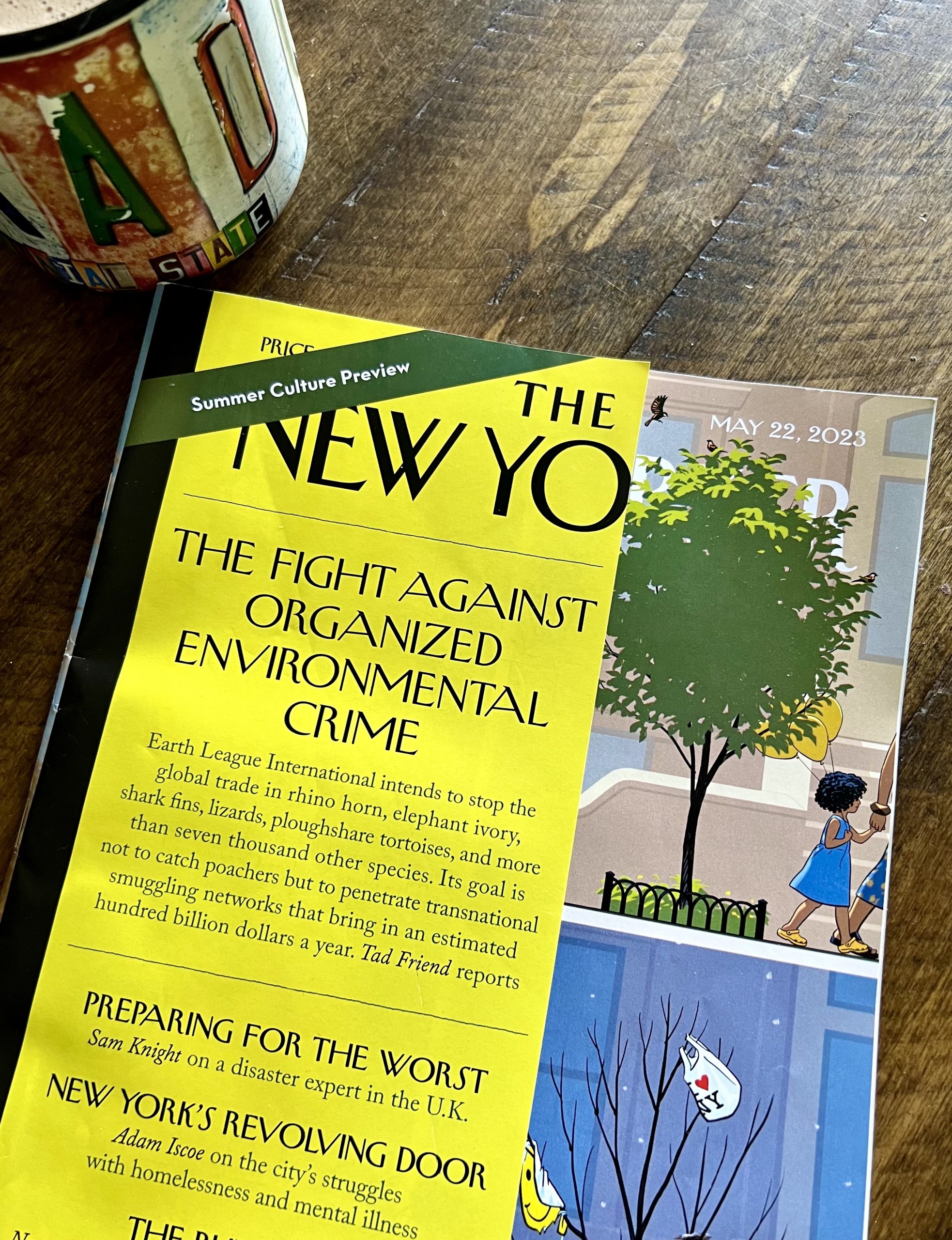
ELI’s investigations underpin two of the most important wildlife documentaries of the past decade — Netflix’s The Ivory Game and National Geographic / Disney+’s Sea of Shadows, both executive produced by Leonardo DiCaprio. In May 2023, ELI was the subject of a cover story in The New Yorker, “Earth League International Hunts the Hunters.” Our work has been featured in hundreds of articles across the world’s most influential media, including The Washington Post, National Geographic, CNN, The Guardian, The New York Times, Wired, Libération, Al Jazeera, and Smithsonian, and podcasts.
Beyond the headlines, ELI produces in-depth public reports that are widely regarded as among the most comprehensive an NGO has published in this field — used and cited by law-enforcement agencies, researchers, policymakers, and academics worldwide, and making information on environmental crime networks available where almost none existed before.
We have also pioneered new ways of reaching people. Our graphic-novel series — the first dedicated to environmental and wildlife crime, and featured in The Washington Post — translates the complex realities of these criminal networks into a form that engages an entirely different audience.
HOW WE MEASURE OUR IMPACT
Everything above is the result of a discipline most NGOs don’t apply to themselves: we measure our own work as rigorously as we investigate the networks we target.
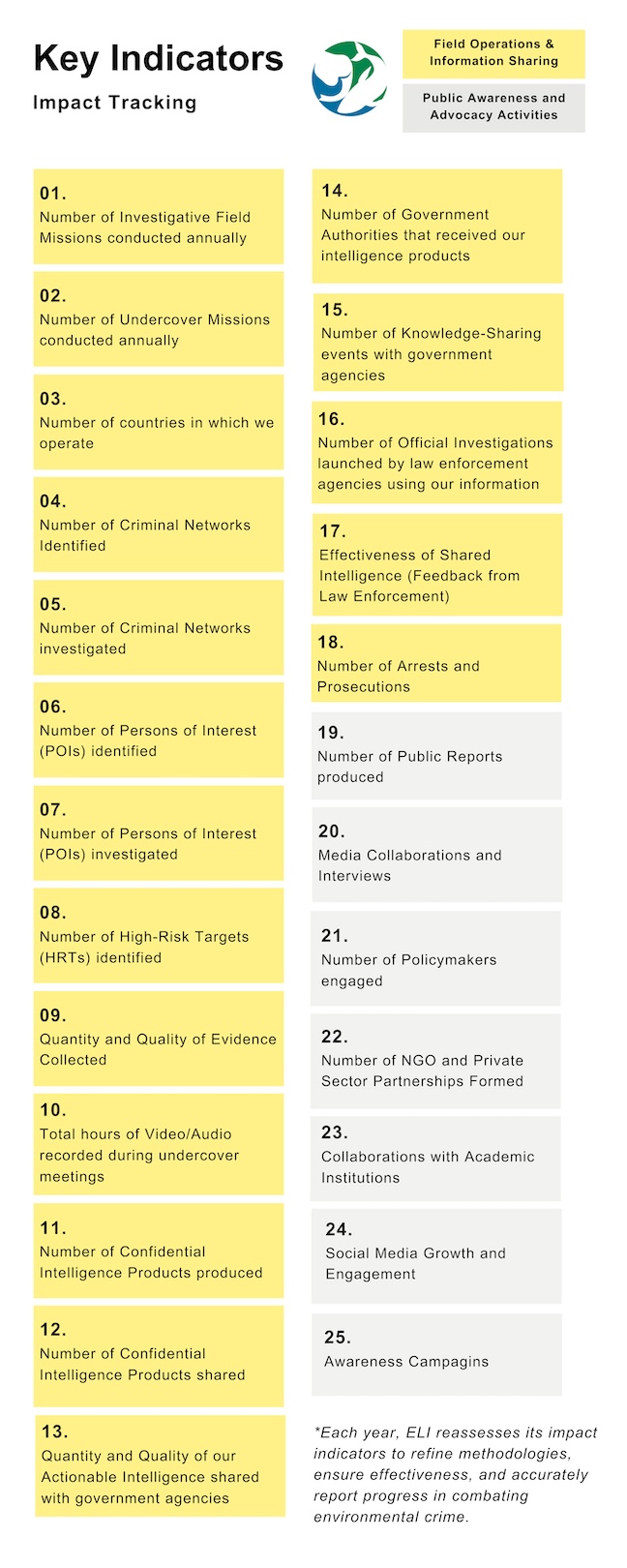
Because environmental crime is complex, transnational, and often fought out of public view, impact here cannot be captured by a single number. ELI has therefore developed a framework of 25 Key Indicators that track the multi-level, long-term effects of our work — from intelligence produced and networks mapped to arrests supported, policies informed, and partnerships built. We use them to hold ourselves accountable, to sharpen our methodology, and to report honestly and accurately to the partners and supporters who make our work possible.
Impact tracking matters to us because the threat is serious and the resources devoted to fighting it are finite. Measuring what works — and what doesn’t — is how we make sure that every operation, every brief, and every dollar goes as far as it possibly can.