MONEY TALKS: What Criminals Told Us About Corruption
ELI Releases Corruption Report Drawing on Ten Years of Undercover Intelligence
New report reveals how corruption — observed firsthand from inside criminal networks — is the invisible engine driving environmental destruction worldwide, and why no law, policy, or institution can survive when corruption is allowed to thrive
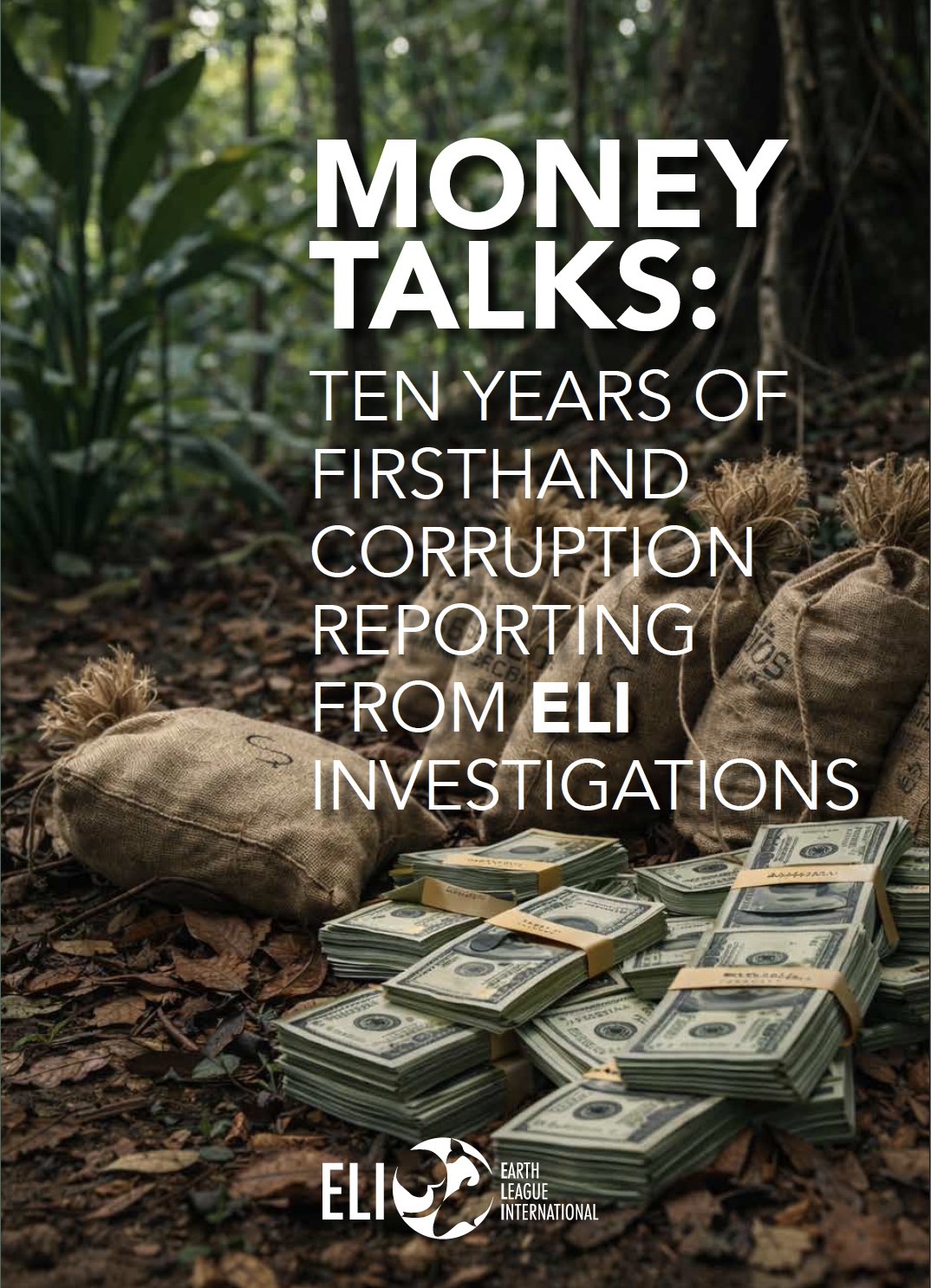
Earth League International (ELI) today released Money Talks: Ten Years of Firsthand Corruption Reporting from ELI Investigations, a landmark report exposing how corruption functions as the central engine of environmental crime, seen not from the outside, but from within the criminal networks themselves. The report synthesizes over a decade of undercover field operations across Latin America, Africa, Southeast Asia, and Europe, offering a rare and unprecedented view of how bribery, collusion, and impunity operate in practice, through the words and actions of the traffickers, brokers, and corrupt officials who sustain them.
 Intelligence From Inside the Criminal World
What sets Money Talks apart from virtually all existing corruption analyses is its source material. Most reports on corruption are built on open-source data, arrest records, or interviews with law enforcement officials. ELI’s report is built on something far rarer: the direct, firsthand testimony of the criminals themselves.
Over more than a decade, ELI’s undercover operatives embedded within some of the world’s most significant transnational criminal networks — building trust over years at personal risk — to document how corruption actually works from the inside. The result is 45 mini case studies from field operations spanning dozens of countries, capturing corruption events as they unfolded: the negotiations, the payments, the arrangements, and the networks of officials and private-sector enablers who keep the system running.
This perspective — from within the machinery of crime — is essential. To effectively disrupt corruption, we must understand how criminals think about risk, calculate bribe amounts, assess the vulnerabilities of officials, and adapt to enforcement pressure in real time. Without that inside view, countermeasures remain reactive, partial, and incomplete.
When Corruption Flourishes, Nothing Else Can
A central and urgent finding of the report is that corruption does not merely undermine anti-crime efforts, it systematically dismantles them. Agencies refuse to share information due to distrust. Whistleblowers stay silent for fear of life-threatening leaks. Communities lose faith in their leaders and institutions. Evidence disappears. Cases collapse. And the criminals grow wealthier, stronger, and more resilient.
The report documents how robust anti-corruption frameworks exist on paper in many of the countries ELI investigated, yet remain largely ineffective because corruption has infected the very institutions responsible for enforcement. In Mexico, 731 federal anti-corruption complaints under one administration yielded a single conviction. In Peru, at one point every living former president was under criminal investigation. In country after country, ELI’s sources confirm that the rule of law cannot take hold where corruption has become the operating system.
This is not a problem confined to less wealthy nations. During investigations into illegal wildlife trafficking for traditional Chinese medicine in Europe, ELI collected information from various Persons of Internet about allegedly complicit officials in Italy and Poland. Corruption is everywhere and it is everywhere a force multiplier for the crimes it enables.

Key Findings
Among the report’s most significant findings:
- Corruption is the primary enabler of crime convergence, protecting Transnational Criminal Organizations (TCOs) as they grow, diversify, and expand across borders and criminal sectors.
- Bribe prices are market-driven and responsive to enforcement pressure. In one documented case, bribes to police increased fivefold as enforcement tightened, from $200 to $1,000.
- Criminal networks conduct sophisticated assessments of officials’ vulnerabilities, from debt to family relationships to political transitions, before approaching them.
- Environmental defenses are only as strong as the weakest link. TCOs systematically identify and exploit the most corrupt checkpoints, ports, and officials along every supply chain.
- Corruption reaches the highest levels of government in many countries, with some heads of state and their families directly implicated in facilitating wildlife and environmental crime.
- Based on ELI’s decade of field experience, long-term intelligence collection and undercover operations remain the most effective means of detecting and attacking corruption. Only by gaining the trust of criminal networks from the inside can investigators understand how corruption truly functions, identify the officials and enablers who sustain it, and generate the actionable intelligence needed to disrupt it.
Download the report here: ELI – Corruption Report – March 2026
“Our undercover teams have spent over a decade sitting across the table from the world’s most significant environmental criminals, listening to them explain, in their own words, how they buy protection, move contraband, and stay in business. What they describe is a world in which corruption is not the exception but the rule. This report is our attempt to bring that reality into the open, and to give practitioners, governments, and civil society the concrete intelligence they need to fight back.”
— Andrea Crosta, Founder and Executive Director, Earth League International
###
For media inquiries contact: info@earthleagueinternational.org